Large language model (LLM): meaning and practical example
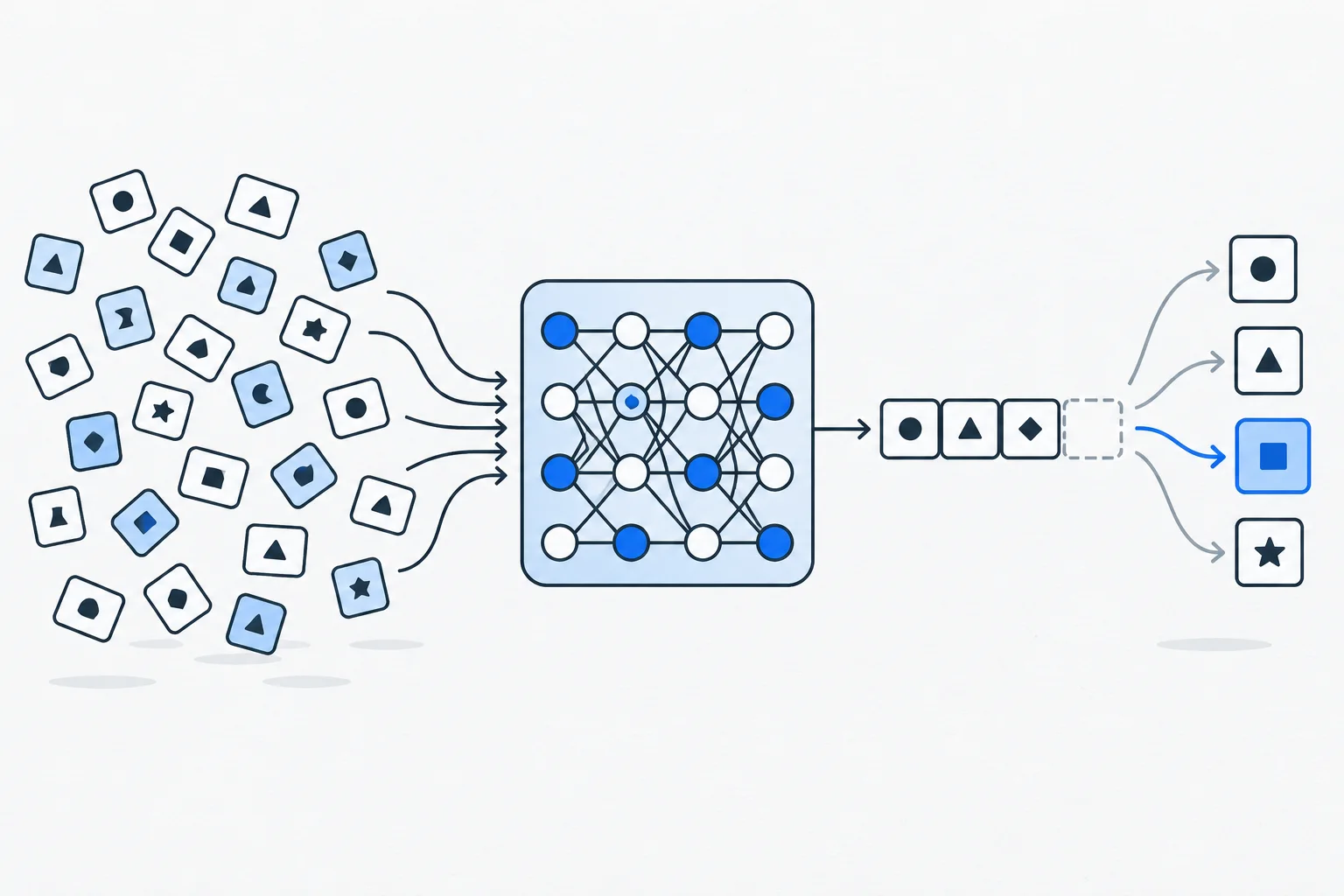
A large language model, or LLM, is a machine-learning model trained on large amounts of data to process and generate text using learned language patterns. It handles text in units called tokens. By itself it is not a search engine, current database or complete AI assistant.
Also known as: LLM · language model
At a glance
- An LLM is a component; an application may connect it to search and other tools.
- Fluent text does not establish factual accuracy.
- Patterns learned during training differ from sources supplied for the current task.
On this page
What is the model's role?
A language model produces output from its input and patterns established during training. It works with tokens, which can be words, word fragments or other units depending on the tokenizer.
Google's machine-learning course explains the underlying principle. Business users need not master every mathematical detail to understand a crucial distinction: generating a well-formed answer and verifying its facts are different operations.
How does a complete AI application differ?
An assistant can combine the model with search, document storage, access controls and an interface. When it retrieves current web information, it may be accessing a separate source rather than recalling training information.
AI search is therefore broader than text generation. RAG, for example, supplements generation with retrieved documents. A model name alone does not establish a service's capabilities: examine available information and tools for the actual task.
A model’s knowledge cutoff concerns the time coverage of its training information, not the publication date of every source an application can retrieve. A search tool may supply newer evidence without changing the model’s training. Conversely, a recent cutoff does not guarantee complete or accurate knowledge of every earlier event; check the evidence actually used for the answer.
What do the prompt and context contribute?
A prompt states the task and may include background material. The context window limits information available at once. An uploaded document or conversation history can inform a response without automatically becoming permanently learned knowledge.
If you supply a new price list, an assistant may use it in that context. This does not imply every other user or later conversation knows the list. Product data handling and functionality require separate investigation.
Example: summarizing a service description
Imagine a moving company requesting a short introduction from three approved documents. The model can consolidate repeated wording and organize services clearly. The owner does not want invented packing or storage services added.
A useful result needs a clear task, suitable sources and editorial review. Fluent sentences do not establish that the business actually offers each service. This illustrates a workflow, not measured product performance or a recommendation for a model.
Language assistance and business authority are separate: the model helps with wording, while company documentation establishes valid commitments.
Why can answers be wrong?
An AI hallucination can present convincing but incorrect or unsupported names, numbers, links or interpretations. The language may remain entirely natural.
Review more than spelling and tone. For every important claim, check its source and whether that source actually supports it. Current prices, deadlines, product details and service conditions deserve particular attention because errors can directly mislead customers.
How should usefulness be evaluated?
Use a concrete task with verifiable expectations. Summaries need fidelity; explanations need clarity; comparisons need appropriate criteria and explicit missing data. Longer or more confident output is not automatically better.
The model is one workflow component. Data quality, instructions, tools and review jointly shape usefulness. Assess it on real tasks, known sources and consistent criteria rather than relying solely on an impressive demonstration.