AI hallucination: fluent answers with unsupported claims
An AI hallucination is a false, invented or unsupported claim produced by a generative AI system. It can sound fluent and confident. It does not imply deliberate deception, and a visible citation does not guarantee that the claim is supported.
Also known as: AI hallucination · hallucinated answer · fabricated AI claim
At a glance
- Confident wording is not evidence that a claim is correct.
- Retrieval and grounding can help, but sources can be wrong or misinterpreted.
- Verify material facts and promises before publishing AI-assisted content.
On this page
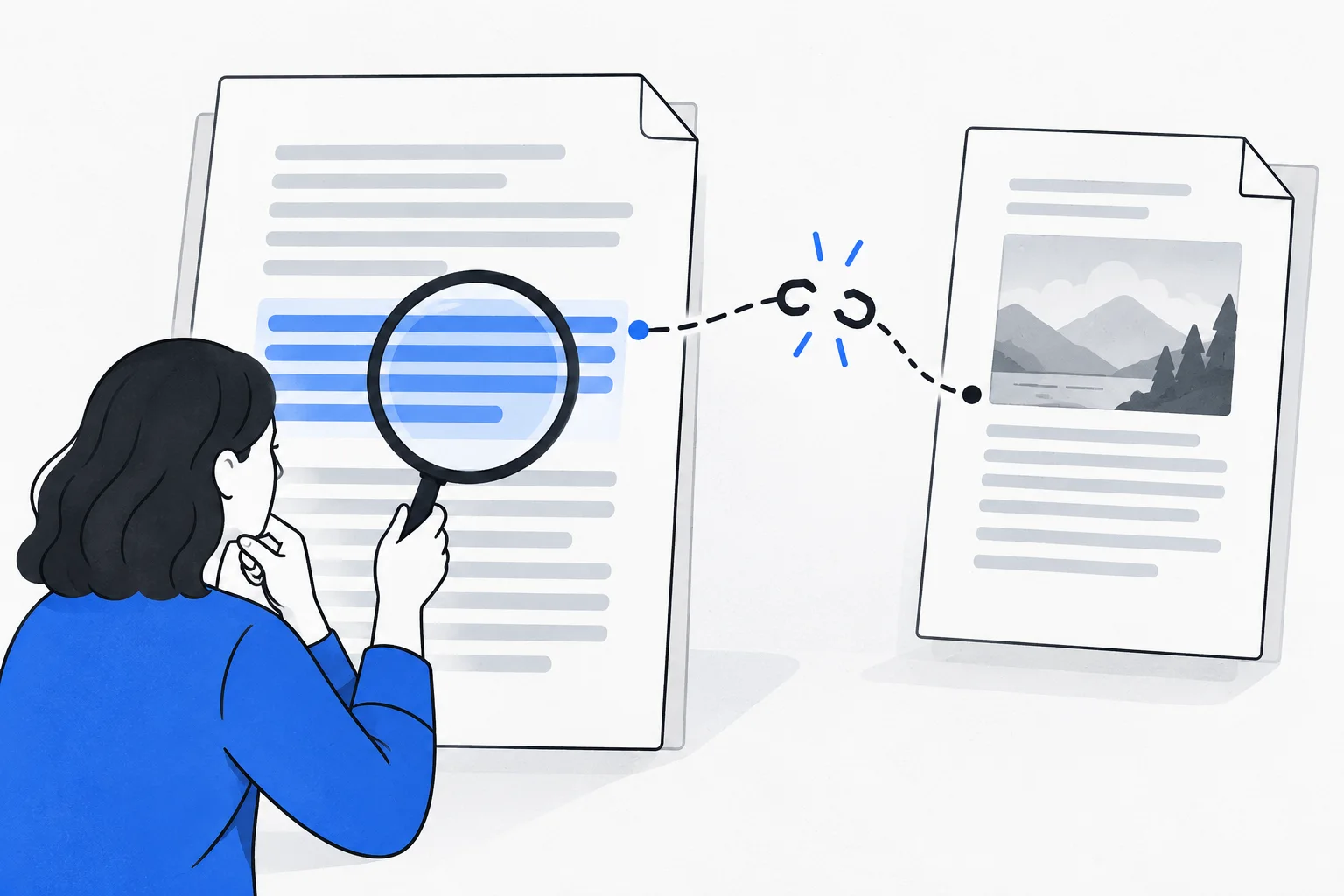
What does a hallucination look like?
Some errors are obvious: a nonexistent book, an invented webpage or a quotation nobody wrote. Others are harder to spot. A system may attach a real price to the wrong period, confuse two packages or present a conditional statement as a guarantee.
A language model's ability to produce plausible text does not establish the truth of every statement. OpenAI's accuracy guidance describes limitations that make independent verification important.
| Possible error | Useful verification question |
|---|---|
| Invented reference | Does the cited document actually exist? |
| Incorrect factual detail | Does the original source contain this fact? |
| Misread condition | Does the claim apply in this context? |
| Unsupported generalization | Does the evidence justify every case described? |
Example: a service the business does not offer
Imagine a fictional office-cleaning company whose website describes routine office cleaning. A generated article adds that the company offers emergency weekend visits, although no supplied information establishes that service.
The problem is not simply an overly confident tone. The business must verify whether the service exists and remove the claim if it does not. Rephrasing it as “usually available” still invents a commercial promise.
This is an illustrative scenario, not an actual customer incident. Similar errors can concern opening hours, service areas, prices and delivery deadlines. Those details can affect a customer's decision and deserve particular attention.
Do grounding and retrieval prevent hallucinations?
Grounding connects an answer to specified information. Retrieval-augmented generation can supply relevant documents before an answer is written. Both can help, but neither guarantees accuracy.
A retrieved document may be outdated, incomplete or incorrect. The system may combine incompatible sources or misunderstand a condition. A source link therefore needs the same claim-level checking as an answer without one.
When the evidence does not establish an answer, acknowledging the gap is preferable to filling it with a plausible guess. Google Cloud's grounding documentation explains the relationship between generated responses and supporting information.
What can a better instruction accomplish?
Identify the evidence the system should use and ask it to distinguish supported facts from uncertainty. Avoid requesting exact numbers where no reliable data exists.
An instruction such as “do not invent anything” expresses a useful requirement, but is not a technical guarantee. Breaking a draft into claims and checking their sources is stronger than relying on a single reassurance from the same system.
What should be checked before publication?
Review names, dates, quantities, prices, quotations and service promises. Open the sources and confirm that they support the wording and its scope. Do not assume a citation is valid merely because its title looks plausible.
Correct unsupported claims, omit them or clearly label genuine assumptions where an assumption is appropriate. After removing a sentence, read the surrounding explanation again: the conclusion may still depend on the deleted claim.
Editorial review should protect the meaning of the whole article, not just eliminate spelling mistakes. The goal is a useful explanation whose important statements can be defended.