Business Profile category: describe the real business type
A Business Profile category is a classification offered by Google that identifies a business type or activity. The primary category describes the main operation, while additional categories can clarify genuine additional activities. It is not a free-form keyword list or the same as website article categories.
Also known as: Google Business Profile category · business category
At a glance
- Choose from Google’s available categories to describe the actual business.
- Primary and additional categories play different roles.
- Adding a category does not create a service the business does not provide.
On this page
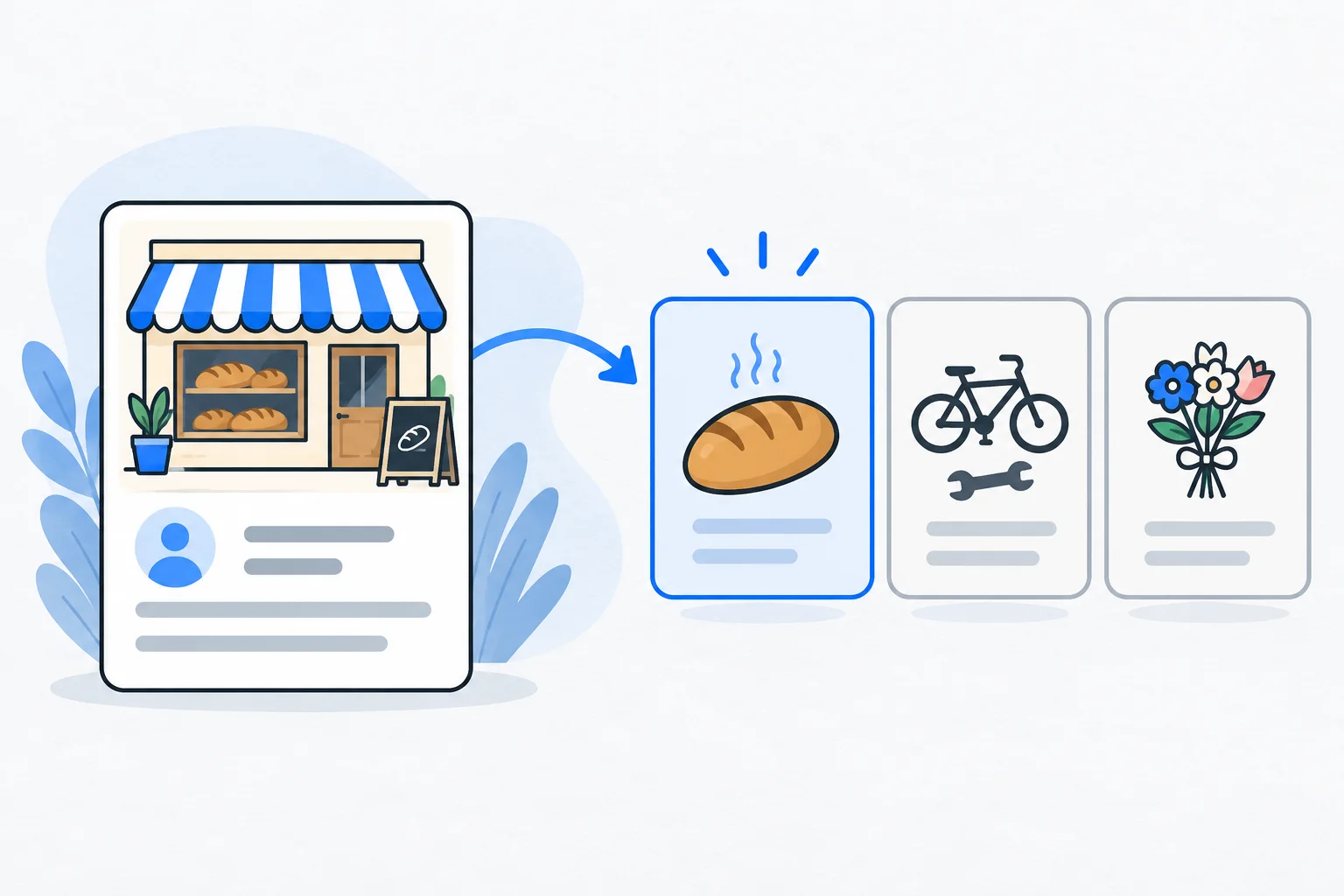
What question does a category answer?
It identifies the kind of business. “Bakery” describes a business type, while “sourdough bread” generally describes a product. Confusing those levels can lead to trying to represent every item as a separate category.
A category gives quick orientation on a Google Business Profile. It does not replace a detailed service explanation. “Bicycle repair shop” does not explain which bicycles are accepted, how intake works or when a quote is prepared.
How should the primary category be selected?
Ask what most accurately describes the real main activity. Google's category guidance describes selecting an appropriately specific option from the available list. If an exact option is absent, a truthful broader classification may be suitable.
A category is not simply a keyword. Select it because it applies, rather than because it sounds popular. Actual customers, staff capabilities and daily operations provide useful checks. A competitor's setting is an observation, not an instruction to copy it.
When is an additional category justified?
An additional category can identify a real, distinct activity. Every product or small service variation does not need one. An overly broad list can attract people whose needs the business cannot meet.
Another independent business sharing the premises should not automatically be absorbed into your categories. A shared address does not necessarily mean a shared operation. Google's representation guidelines help distinguish separate businesses and departments.
Clarify the organization and customer-facing arrangement before choosing a category for an uncertain case.
Example: a bakery with a café
Imagine a Debrecen business baking bread and operating a seating area with breakfast and coffee. The owner must decide which category describes its main activity and which represents a real continuing additional service.
Occasional cake orders do not automatically make every pastry-related classification appropriate. The team reviews its actual offer, hours and typical reasons customers visit.
The website separately explains takeaway bread collection and eating on the premises. Those reflect different search intents. If the seating area later closes, review profile categories and related information as well as the website paragraph.
What does a category change not prove?
Categories matter to local SEO, but are not a single ranking switch. A changed search appearance afterward can also involve location, timing and other conditions. The sequence alone does not establish causation.
A category is not a certification of qualifications, service quality or special authorization. Nor should a business select a category merely because it wants to attract those customers before offering the service.
How should categories align with content?
Profile classifications and main service pages should have a meaningful relationship. On-page SEO can name the activity in headings and introductions, then explain its actual conditions.
Record why each category was chosen. Review the decision when activities begin, end or change. Accurate business representation is a stronger basis than constant unexplained experiments with classifications.