Search results and measurement
What is a zero-click search?
A zero-click search is an observed search after which the user does not click a displayed result; the exact classification depends on the study’s measurement rules.
Also known as: zero-click search · zero click
At a glance
- No click to your own website does not establish that the search had no clicks anywhere.
- A result click, a click to a Google-owned surface and a visit to the open web are different outcomes.
- A broad study’s percentage is not your business’s measured loss or proof of AI’s causal effect.
On this page
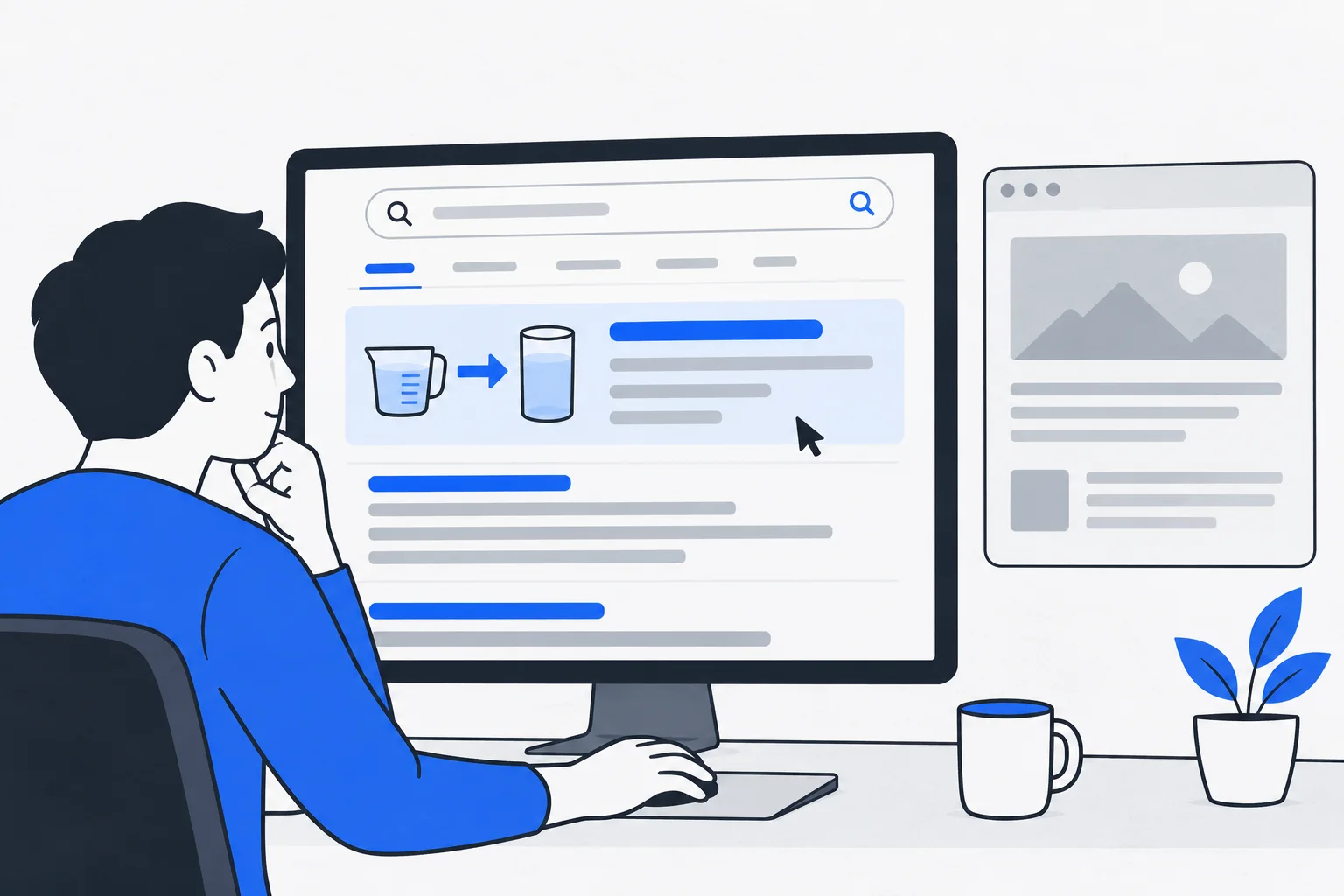
What can happen without a click?
Someone asking how many grams of sugar fit in a tablespoon may find a short answer sufficient. Another person may find nothing useful and rewrite the query. Both searches can end without a result click, while only the first clearly satisfies the task.
A featured snippet, knowledge panel or AI answer can provide information without opening a website. That does not mean every such appearance eliminates a potential visit: someone may still click for details.
Which click outcome are you discussing?
“No one clicked my website,” “no result was clicked” and “no visit went to the open web” are different statements.
Consider this invented sample of 100 searches, with one outcome assigned to each for simplicity:
| Outcome | Searches |
|---|---|
| No result click | 40 |
| Clicks only to Google-owned surfaces | 20 |
| A click to an external website | 40 |
The zero-click share in this example is 40%. The share without an external-site visit is 60%. Substituting one number for the other would mislead. Real studies can include multiple clicks and more complex journeys, making the methodology essential.
Why can you not calculate it from your CTR?
CTR divides clicks by impressions for the defined result or reporting scope. Fifty clicks from one thousand impressions gives a 5% CTR. The remaining impressions do not tell you how many users clicked competitors, advertisements or another result.
Google Search Console describes your own search performance. It is not a complete browsing log of everybody’s subsequent actions. A 95% “did not click my result” share is therefore not a 95% zero-click-search rate.
How should you read a study?
Check its countries, period, devices, data provider and rules for deciding when a search ends. Panel coverage matters: web searches and searches inside a mobile app are not necessarily observed in the same dataset.
The cited studies use different providers and periods. Those differences limit direct year-to-year comparisons. An observed change does not by itself separate the influence of AI Overviews, changing behavior and measurement design.
A broad study also cannot establish a Hungarian industry-specific rate, or your own lost revenue, without suitable additional data.
What can a small business do?
Imagine a bicycle repair shop giving a direct answer about tire pressure, then explaining how tire size, load and use affect the decision. The additional detail serves a real task. Hiding the basic answer artificially would only make the page less useful.
Evaluate relevant organic clicks, inquiries and customer questions. A brand discovered in search may receive a later inquiry, but that is not revenue evidence until it is observed. Equally, an absent click is not automatically a lost sale. Keep the available evidence and the proposed business interpretation separate.