Search results and measurement
Featured snippet: meaning and practical example
A featured snippet is an answer excerpt drawn from a web page and displayed prominently in Google Search. It highlights an explanation and links to the original page. It differs from both a meta description and a generative AI summary assembled using multiple sources.
Also known as: highlighted answer · position zero
At a glance
- Google chooses featured snippets for particular questions.
- There is no special markup that guarantees a featured snippet.
- A short answer is useful when it remains accurate and includes necessary conditions.
On this page
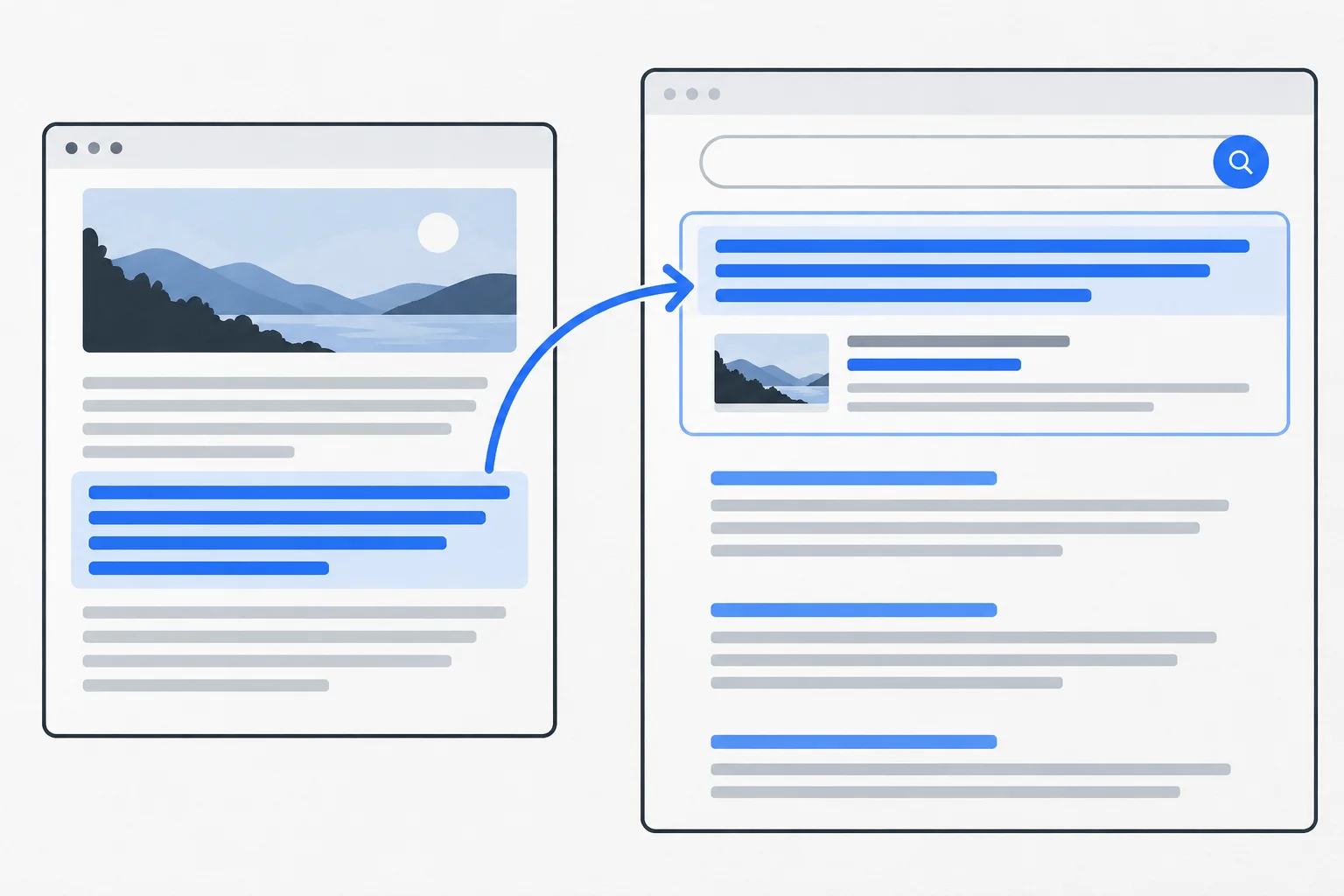
Where do featured snippets appear?
For some questions, Google displays an answer excerpt more prominently than an ordinary result. The excerpt links to a source page the reader can open. It can appear as a highlighted result or within answers to related questions.
Google's documentation describes this as a distinct search appearance. A SERP can contain several different elements, so a prominent answer is not automatically an AI response. Identifying its actual format helps you interpret both the content and its measurement.
How does it differ from a meta description?
A meta description is metadata summarizing a page. A search engine may use it, but can also assemble the result description from other page content. A featured snippet instead highlights an excerpt answering the question.
These require different editorial work. A meta description explains what the page covers and why to open it. A definition or answer paragraph resolves the question itself. An attractive marketing sentence cannot replace an accurate explanation, and repeating the keyword does not make an answer better.
How is it different from an AI Overview?
Google AI Overviews are generative summaries that can include supporting source links. A featured snippet extracts an answer from a source page. The two formats use and organize information differently.
People Also Ask is a related-question interface that can also contain highlighted answer excerpts. Keep these concepts distinct. When documenting a page's appearance, record the type of result and the query that produced it.
Example: a straightforward definition
Imagine a furniture website explaining veneer. Its opening paragraph defines the term; later sections discuss the surface layer, underlying material and uses. The first paragraph makes sense independently, while the rest supplies important distinctions.
This helps readers, but does not promise that Google will highlight it. The example describes an editorial approach, not an observed search result. A useful definition captures the essential meaning accurately and lets later sections develop the conditions.
An oversimplified sentence can mislead by omitting a crucial exception. Brevity is valuable alongside accuracy, never as a substitute for it.
How do you write a clear answer?
Establish the search intent, then answer the real question directly. For a definition, identify the concept; for a process, show the sequence; for a comparison, use consistent criteria. Structure should support understanding rather than an imagined compulsory word count.
Google provides no page markup that guarantees selection. Its systems choose the excerpt. The editorial aim is therefore clear, reliable information. A neatly formatted paragraph without evidence does not become trustworthy through presentation alone.
What should you check after an appearance?
Check whether the shortened excerpt means the same thing as the full explanation. Does the original section include essential conditions, and does its link lead to an appropriate destination? If the source has become outdated, correct that page first.
A featured appearance does not by itself establish better business results. Examine available search and website data without attributing every change to one observed result. An appearance is an observation; evaluating content performance requires additional evidence.