What is search location?
Search location is the geographic context a search engine uses to interpret a query, potentially derived from device, network or other available location information.
Also known as: search location · geographic search context · localized results
At a glance
- Location can matter even when the query contains no city name.
- The searcher’s location can differ from the destination named in the query.
- Record geography when comparing positions or local results.
On this page
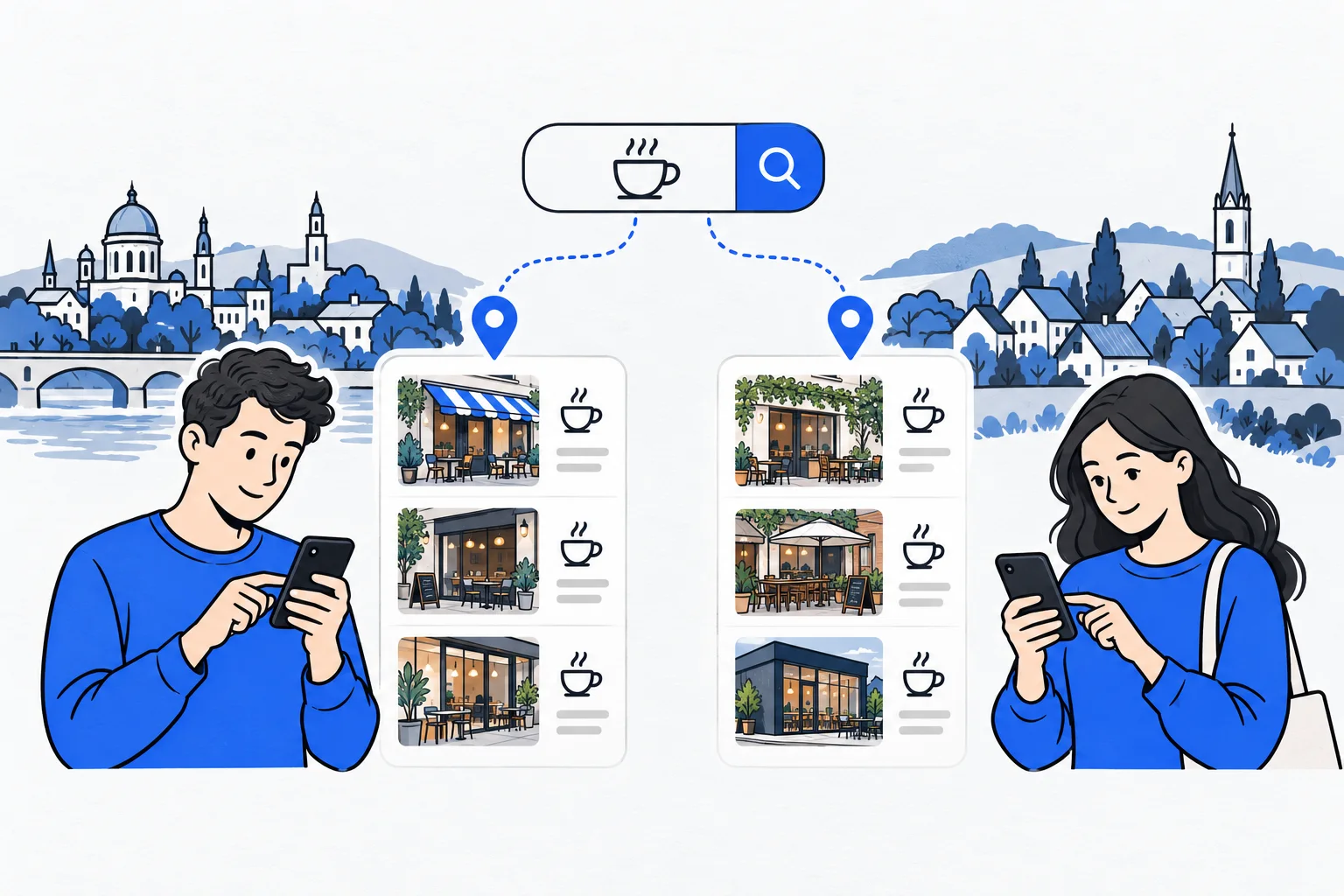
Why can location matter without a city name?
Someone searching “bicycle repair” often wants a workshop they can reach. A search engine can therefore use geographic context to provide locally relevant results even when the search query does not specify a city.
Google describes several possible location sources. Device permissions, network information and other available context can provide different levels of precision. The location used by the search engine is not necessarily an exact reading of where the person stands.
Is this the same as a destination in the query?
No. A person in Budapest can search for accommodation in Pécs. The named destination is central to the task, while the search itself originates elsewhere. Record them separately when researching results.
Search personalization is another concept. Location, language and device can affect results even when personal history is not being used. An incognito window therefore does not create one universal, location-free result list.
An example: two searches for a florist
Imagine a florist in Győr. The owner searches for flower delivery from home, while a colleague repeats the words from another city. Their results can differ.
That does not establish that one result is incorrect and the other is the business’s one “real ranking.” Record the query, time, device and geographic context. If the task is to study delivery searches in Győr, use an observation setup that reasonably represents that task.
This is an illustrative scenario, not a live measurement of a particular florist or evidence of a ranking change.
What does location mean for local SEO?
Local SEO begins with accurate business information and service coverage. Google discusses distance alongside other local-ranking considerations. Repeating more city names on a page does not make the business physically closer to a customer.
An address or service area in Google Business Profile describes the business. It is not the same data point as the searcher’s location. Invented premises or misleading geographic claims also create problems for the person trying to use the service.
How should you compare observations?
Keep the chosen location consistent in rank tracking. If you investigate another market, treat it as another observation series. Differences between cities may matter commercially, but one blended average should not be presented as if every place behaves identically.
Average position in Search Console summarizes impressions within its reporting scope. It need not match the numbered position seen in one manual local search.
Both observations can be useful when their contexts and counting rules are clear. Before interpreting a changed result as a website problem, check whether the search conditions changed as well. A reliable comparison starts with comparable observations.