Negative keyword: meaning and practical example
A negative keyword is a Google Ads setting that restricts an ad from appearing for particular searches. It helps exclude needs unrelated to the offer. Its behavior depends on match type and campaign; it does not prevent the website from being indexed or exclude the page from organic search.
Also known as: keyword exclusion
At a glance
- An advertising exclusion is entirely different from a noindex instruction.
- Negative matching does not treat every variant the same way as a targeting keyword.
- An excessively broad exclusion can block valuable searches.
On this page
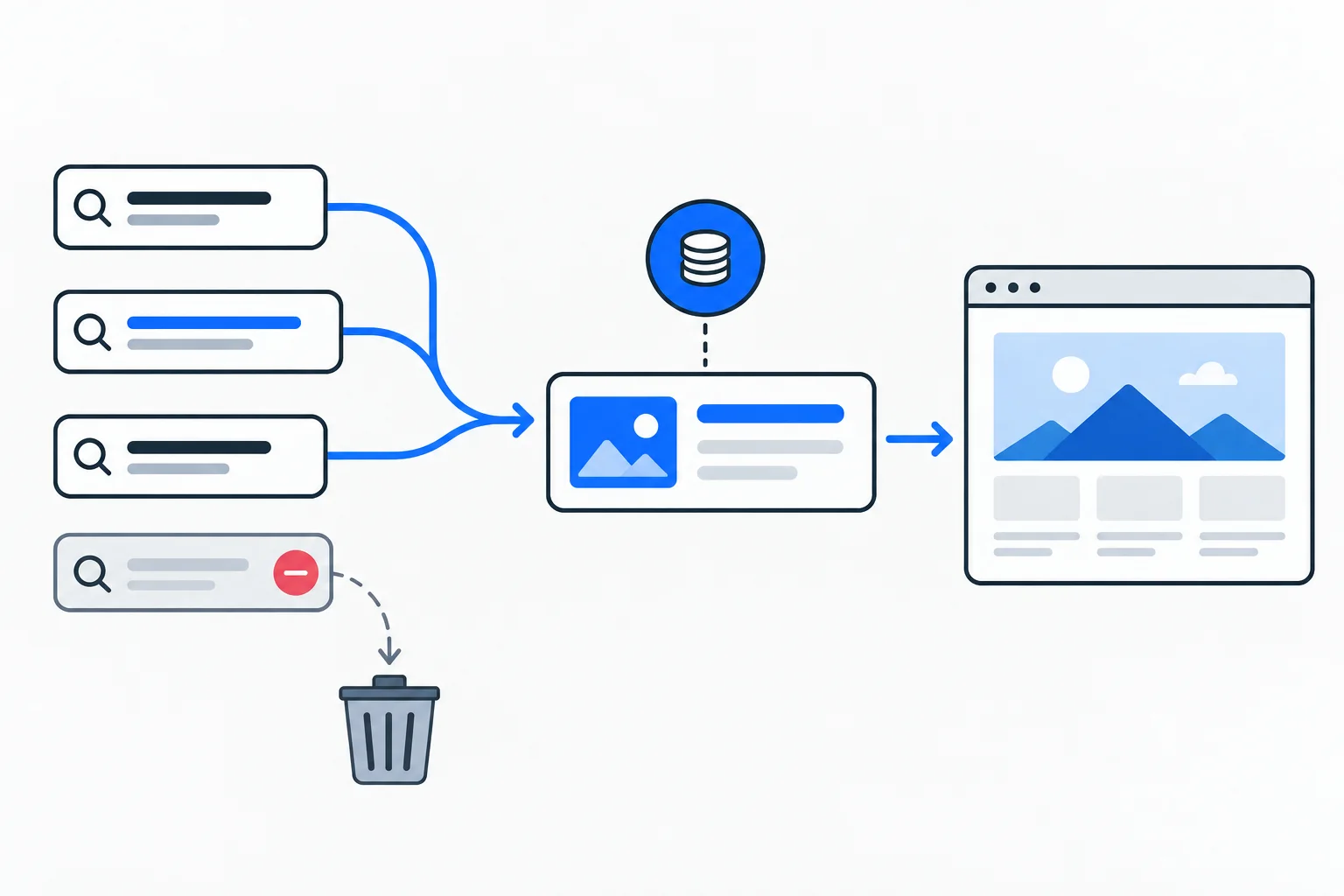
Why exclude a search?
An advertising topic often covers different needs. “Lock” may mean a door lock or a bicycle lock, while a business sells only one. “Rental” may not suit a company that only sells products. Exclusions help manage searches that do not match the actual offer.
Start with the real search query, rather than a universal blocklist. Understand what the searcher wanted and why the campaign cannot satisfy it. Only then design an exclusion using the actual campaign settings.
How does match type affect it?
A positive targeting keyword and a negative keyword do not follow perfectly mirrored rules. Google's negative keyword guide explains distinct matching situations and limitations around close variants. Excluding one form does not necessarily cover every related variation.
Specify keyword match types precisely. A narrow rule for a complete query and a broad exclusion involving a common word can have very different effects. The latter may block searches that would otherwise be valuable.
Why are generic lists risky?
“Free,” “jobs” or “used” can be irrelevant for one business and central to another's offer. Do not adopt an internet exclusion list without checking it. Meaning depends on the complete query and the campaign objective.
Search intent particularly matters for research and comparison queries. Someone who is not ready to request a quote may still be relevant. The business objective determines which earlier decisions the campaign should support.
Example: a bridal salon in Győr
Imagine a salon selling only new dresses, with no rental service. It discovers searches explicitly seeking dress hire. These needs do not match its offer, so a suitable exclusion may be justified.
The owner does not automatically exclude every search containing “cheap.” Someone may be looking for a new dress within a budget the salon can accommodate. The team first examines the full query and available products.
It documents the reason: rental-specific intent is excluded because rentals are unavailable. Later, actual campaign data is used to assess the change. The example promises neither automatic savings nor more customers; it illustrates closer alignment between targeting and the offer.
How is this different from noindex?
Noindex is a technical instruction concerning search indexing. A negative keyword restricts paid advertising eligibility. Excluding “rental” from a campaign does not automatically remove the website's organic results for that topic.
Conversely, adding noindex to a page does not organize advertising keywords. These are different systems and responsibilities. Clarify the precise object of a change before turning a general request to “stop appearing for this” into a technical action.
How do you keep exclusions reviewable?
Record an original query example, business reason and scope for each rule. Campaign, ad-group and account-level application can have different consequences; the operator should check the currently available Ads feature and permissions. Wider scope requires greater care.
Review old exclusions when the offer expands. A previously irrelevant need may become a new service. A sustainable list is a collection of documented business decisions, rather than an untouchable set of words created once.