Long-tail keyword: meaning and examples
A long-tail keyword belongs to the less frequently searched portion of the demand distribution. The “long tail” refers to many individually low-volume phrases, not their word count. They often express specific needs, but low volume alone proves neither easy rankings nor buying intent.
Also known as: long-tail search phrase
At a glance
- Long-tail classification concerns demand frequency, not a required word count.
- A rare query may be valuable without being commercial or easy to rank for.
- Variants serving the same need can often share one page.
On this page
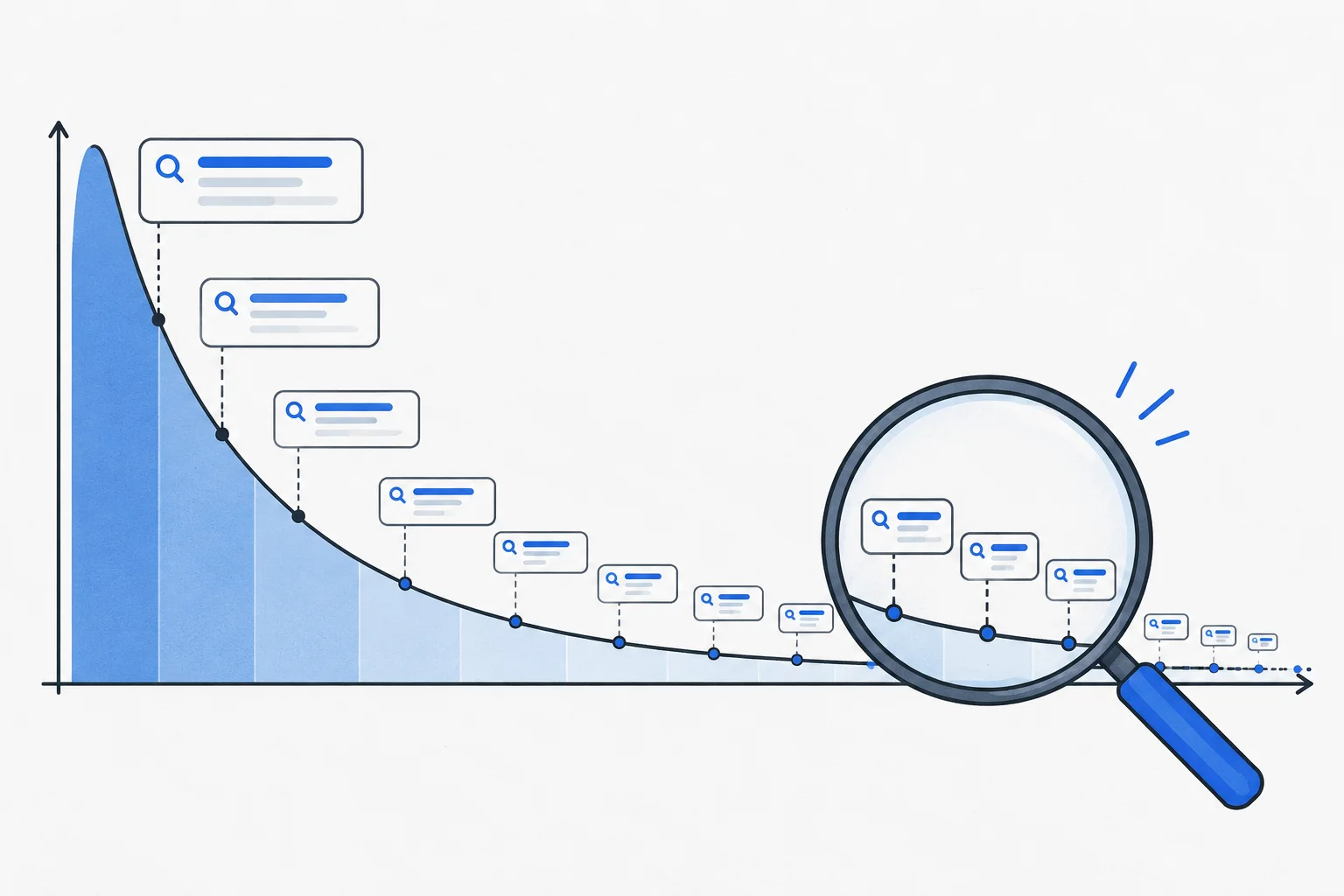
Why is it called the long tail?
Imagine queries arranged on a chart by frequency. A few receive many searches, followed by a growing number receiving relatively few each. This extended portion is the long tail.
Research from Microsoft Research and MIT examines individually rare queries that collectively represent substantial demand. The term describes a distribution. Membership varies by market, with no universal monthly-volume cutoff.
For a keyword, specify the data source, period and market. A phrase rare in one country may be common in another language or region.
Longer phrases are not automatically long-tail
Specific needs often take more words to express, but word count is not the definition. A short product code may be rarely searched; a long familiar question may be common. Neither deserves a confident volume claim without data.
| Phrase type | What the wording tells us | What needs further evidence |
|---|---|---|
| Short unique part code | It may identify a specific item | Search frequency |
| “shoe repair” | A broad service topic | Demand in the chosen area |
| “hiking boot sole repair Budapest” | Product, problem and location | Demand and suitable results |
Search-volume estimates help when read with their methodology. Google Keyword Planner includes close variants, so a row need not represent only one exact sentence.
Example: a shoe repair workshop
Imagine a Budapest workshop frequently receiving questions about detached hiking-boot soles. People ask “can a hiking boot sole be glued,” “repair a detached boot sole” and “hiking boot sole repair Budapest.”
These are possible customer questions, not measured search data. The workshop should establish what it can explain professionally and which work it accepts. It can clarify when repair is possible, when inspection is necessary and which photos help an initial discussion.
Specificity guides the content without a claim of high demand or easy ranking. Answering the customer's actual problem adds value beyond generic promotional copy.
A detailed question does not always imply purchase intent
“How do I glue it back at home?” seeks different help from “where can I repair hiking boots in Budapest?” One may seek a DIY solution, the other a provider. Both are detailed but have different search intents.
Assess audience, offer relevance and a realistic next step rather than inferring commercial value from length. Researchers may need further explanation; provider-seekers may need location, conditions and contact options.
Low volume also does not establish weak competition. A narrow query can have excellent matching pages. Assess actual results and the content you can contribute.
Does every variation need a page?
Not necessarily. Questions about the same problem and solution can share one well-organized answer. The Google starter guide explains that every wording need not appear verbatim for the subject to be understood.
Repair suitability, assessment and contact can fit on one service page. A detailed materials guide may deserve its own page, connected through a useful internal link.
Page boundaries should follow reader tasks. If two versions differ only by town name or word order, examine whether they actually provide separate help.
How should long-tail thinking guide research?
During keyword research, collect specific questions from customers, search data and professional experience. Mark observed searches, customer questions and editorial ideas separately; all can help without representing identical evidence.
Group them by need. Decide where an existing page can improve and where a distinct explanation is missing. The opportunity is to answer overlooked questions well, rather than manufacture many similar pages.
A keyword cluster may combine rare variants. Content-gap analysis identifies unanswered needs, while the primary keyword records the article's focus.