Keyword cluster: meaning and practical example
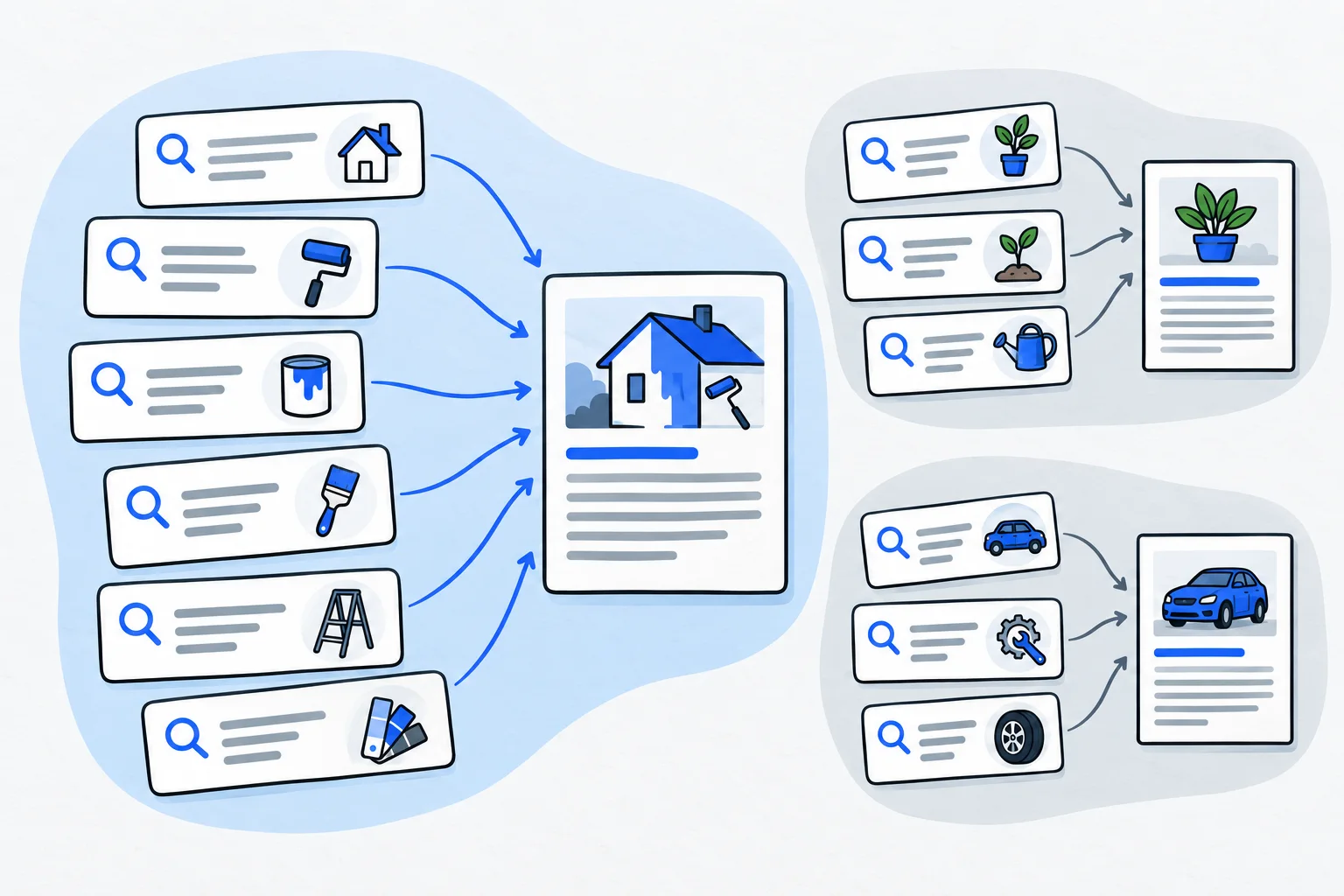
A keyword cluster is an editorial grouping of related search phrases that may represent a shared reader need. It helps determine which phrasings one page should answer. Similar wording is insufficient by itself: meaning, search intent and the search-result context also matter.
At a glance
- One group can combine several phrasings without requiring several articles.
- Automated grouping produces suggestions that need editorial review.
- A keyword cluster organizes phrases; a topic cluster organizes connected pieces of content.
On this page
Why group search phrases?
Research can easily produce ten versions of the same question. “Blind will not open,” “stuck roller blind” and “why does my blind jam?” may concern similar problems, but check their meanings. Assigning a separate article to every wording can create unnecessary repetition.
A keyword here signals a reader need rather than a mandatory string to insert. Grouping helps plan answers. For a useful cluster, you can explain what the reader wants to understand or do and what page would satisfy that need.
When do two searches belong together?
Begin with search intent: do the phrases involve the same problem, decision and desired answer? Shared words can mislead. “Blind repair” and “blind repair cost” overlap, but the second explicitly asks about price.
The SERP provides further clues. Similar results for two queries may suggest a shared interpretation without proving every reader wants the same thing. Record location, time and interface because the observed results can change.
What does automated clustering do?
Some tools group by semantic meaning, others by result overlap or a combination of signals. Semrush's clustering documentation describes one provider's implementation. Interpret results according to the particular method.
An automated group is not a finished editorial plan. The input may omit your business's service boundaries, local operation or specialist distinctions. Decide what you can actually explain and what requires separate treatment. Mark uncertain assignments rather than pretending they are final.
Example: a blind repairer in Kecskemét
Imagine a repairer's list includes “roller blind strap replacement,” “broken blind strap” and “replace blind cord.” The repairer first checks which names refer to the same mechanism and where customers confuse different components. These are research ideas, not phrases with measured volume.
One guide can explain which photographs help before a visit and when an on-site assessment is needed. Its primary keyword names the main problem; related phrasings can appear naturally in the explanation.
“Pairing a motorized blind remote” concerns another action and receives separate consideration. Grouping reduces unnecessary articles without forcing every blind-related question onto one page. The plan remains defensible in terms of customer problems.
How does a topic cluster differ?
A topic cluster organizes several related pieces of content. It might contain an overview, repair guide, selection checklist and definition. They answer distinct questions within a shared subject.
Keyword clustering works at a narrower level: which search phrasings can the same content answer? The terms are not interchangeable. A keyword group does not automatically require a new URL, while a topic cluster is more than a list of similar words.
What should the final group contain?
Record a name, one-sentence reader question, intended page and rationale. Identify phrases with only partial relevance or requiring a separate section. If a suitable page exists, assign that page instead of commissioning a duplicate.
The Google starter guide discusses understandable, organized content without prescribing a universal cluster size. A useful group permits one thorough answer to remain clear. List length alone is neither a quality signal nor a traffic promise.