Search results and measurement
What is People Also Ask?
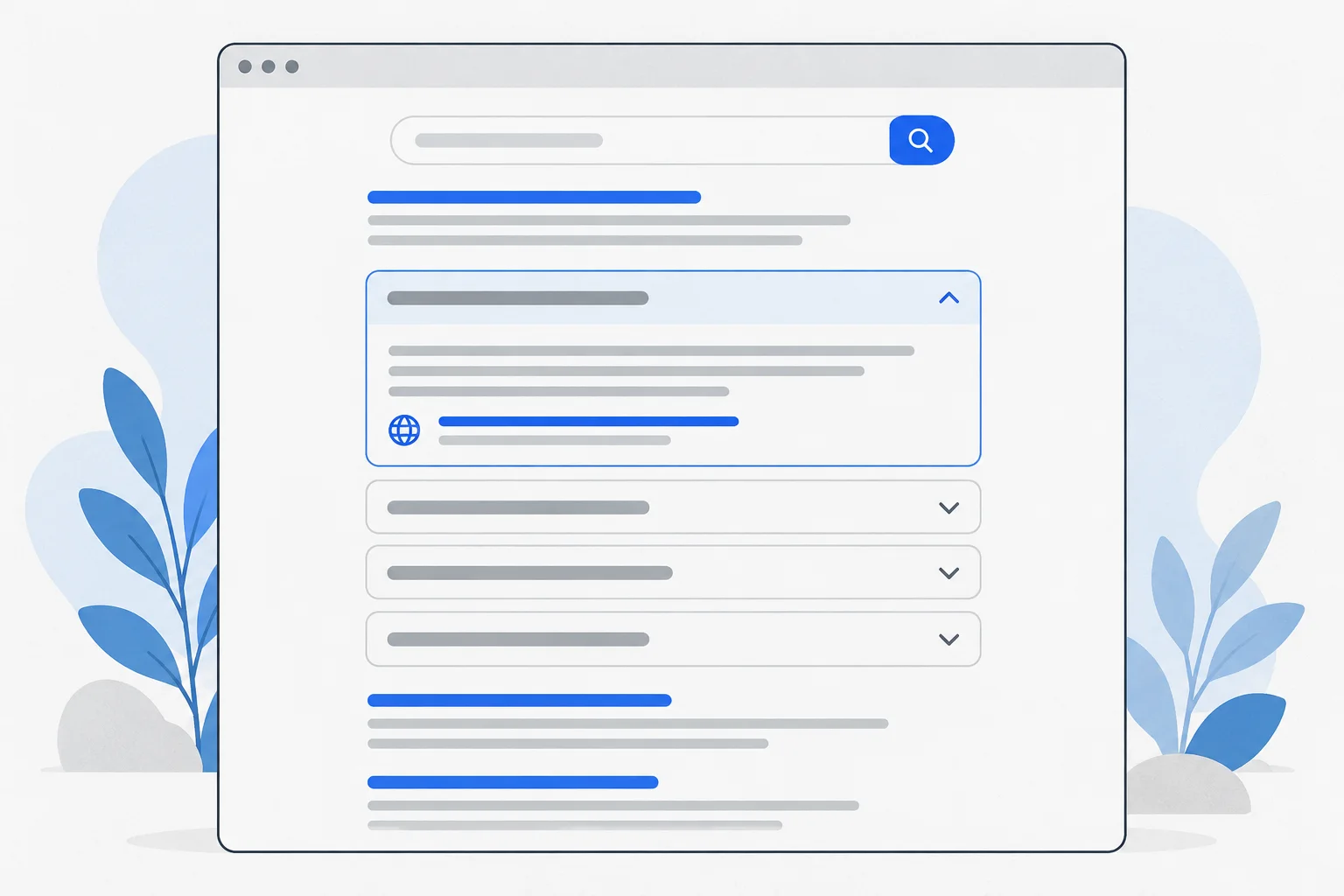
People Also Ask is a Google Search feature that groups related questions, which can expand to show an answer excerpt and a source link.
Also known as: People Also Ask · PAA · related questions
At a glance
- It suggests directions for investigation, not a complete picture of customer demand.
- A displayed question does not reveal its monthly search volume.
- Publishing a useful answer does not guarantee selection for the feature.
On this page
What does the feature display?
Google may show a group of questions related to the original search. Expanding a question can reveal an answer excerpt and a source link. The block is one possible component of a SERP, not the entire result page.
The feature can encourage further investigation of a connected issue. Its presence does not remove the need to check the source and the accuracy of the answer. Nor should every displayed answer be described as a generative AI summary.
How is it different from a featured snippet or FAQ?
A featured snippet describes a particular answer presentation. People Also Ask groups several questions and can contain such excerpts. One term describes an answer format; the other describes the question-group feature.
A website’s own FAQ page is another thing entirely. The publisher chooses its questions and answers for its readers. Creating that page does not mean Google will reproduce those questions in Search.
How can it help content research?
The questions can expose uncertainty, comparison needs or steps that deserve explaining. When examining search intent, distinguish someone clarifying a definition from someone choosing a product or learning a process.
This feature does not replace keyword research. It does not provide reliable monthly search volume, nor establish that every displayed question matters to your particular customers.
Evaluate ideas against business relevance, actual customer conversations and other suitable evidence.
An example: choosing window blinds
Imagine a blinds company researching a buying guide. A related question might suggest comparing manual and motorized operation. The company can assess that idea against questions its own customers ask and the products it actually offers.
A useful explanation would describe the conditions, usage situations and decisions behind the comparison. Copying a question into a headline and filling the page with generic sentences would not achieve that.
This is an illustrative research example, not a claim that a particular question currently appears in Google for a particular query. Documented expertise can add value when its conditions and limits are clear.
Does every question need a separate page?
No. Several phrasings can express the same underlying need. One well-organized explanation can cover them together. Creating many repetitive short pages adds maintenance and can make navigation harder.
A separate page makes sense when it develops a distinct definition, decision or use case. Connect related explanations through natural links, and let the reader’s task determine the boundary rather than differences in word order.
How should you record and verify the research?
Record the observed question, search conditions and source page. Search features change, so a saved observation is not a permanent list.
Open the source and examine what it explains well and what remains unanswered. Verify your own article using primary sources or documented experience. Google selecting a passage does not make it a substitute for editorial responsibility. The final answer should be useful even when someone reaches it without ever seeing the search feature.