Multimodal search: meaning and practical example
Multimodal search uses several input forms, such as an image and text, together to find information. People can show an object and ask about it rather than only describe it. Supported inputs and response capabilities depend on the particular service.
Also known as: image-and-text search
At a glance
- Multimodal search connects several information formats.
- An image and accompanying question can jointly clarify the task.
- Visual recognition and factual correctness each require checking.
On this page
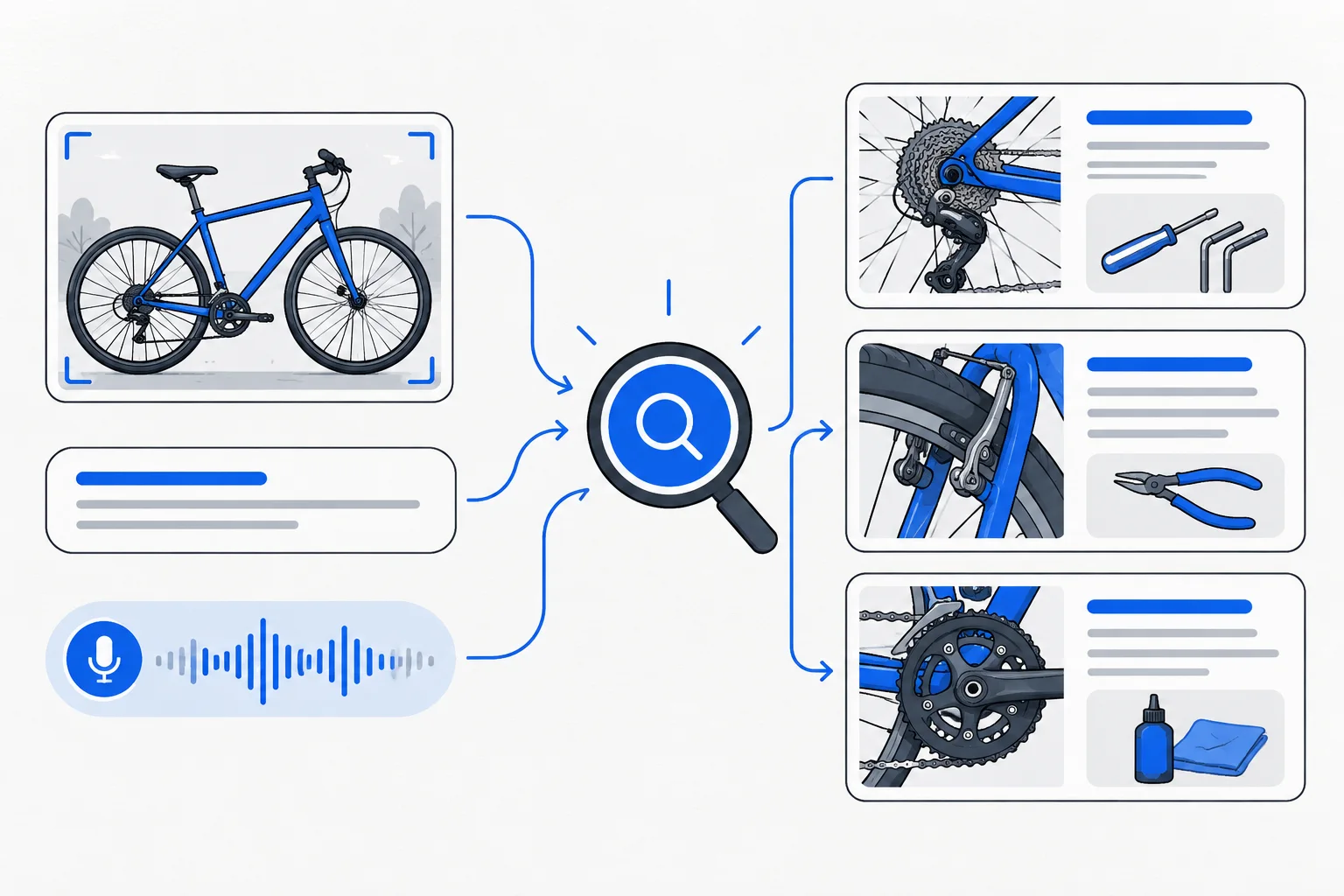
What does multiple input mean?
Text search describes a task in words. A multimodal task can also use images, audio or other supported formats. This helps when someone can see an object without knowing its name, or needs an answer about a visible detail.
A website displaying several media types is not automatically a multimodal search engine. The concept concerns using multiple information forms to interpret the search task. A photograph and question together can communicate more than either alone.
How do images and text clarify each other?
An image can show shape, arrangement or visible details. The question identifies the requested task: naming, comparison, finding something similar or explaining. One photograph can support several tasks.
Google's AI Mode demonstration illustrates image-supported questions. The prompt includes the image and associated request, not simply a standalone sentence. More context still does not guarantee correct recognition of every detail.
Example: an unfamiliar furniture fitting
Imagine a furniture maker photographing a fitting in an old cabinet and asking what type it resembles. The photograph can help with shape recognition. Choosing a replacement also requires dimensions, hole spacing and load requirements that may be invisible.
Search may suggest candidate names to investigate. The maker must still compare measurements and manufacturer information. This is a fictional illustration, not a part recommendation or evidence of a specific search system's accuracy.
The example captures the boundary: a picture conveys visible properties without automatically supplying hidden technical facts.
How is this different from image search or AI search?
Image search often seeks image results or similar pictures. In multimodal search, an image can form part of a more complex question. AI search is broader and can work entirely with text.
Google AI Mode is a product example rather than a synonym for the category. Supported formats and availability change, so distinguish the general principle from a product's current controls.
What does this mean for website images?
Connect images clearly to surrounding content and provide appropriate alt text. The image should reveal something relevant; its caption can explain what matters. Alt text describes that image's role instead of serving as a keyword list.
Do not present an illustration as a product photograph or measurement evidence. Its description should reflect its illustrative role. Useful visual material helps readers without guaranteeing an appearance in multimodal results.
How should results be checked?
Separate recognition from inference. Confirm the identified object or detail, then verify associated claims against suitable sources and the correct variant.
Query fan-out may retrieve several sources for a complex request, but missing data remains missing. Resolve important invisible properties through additional evidence, not the answer's confidence.
Video SEO separately considers playable media, indexable pages and descriptive metadata. Embedding a video alone does not guarantee a video-search appearance.