Content syndication: republishing an article elsewhere
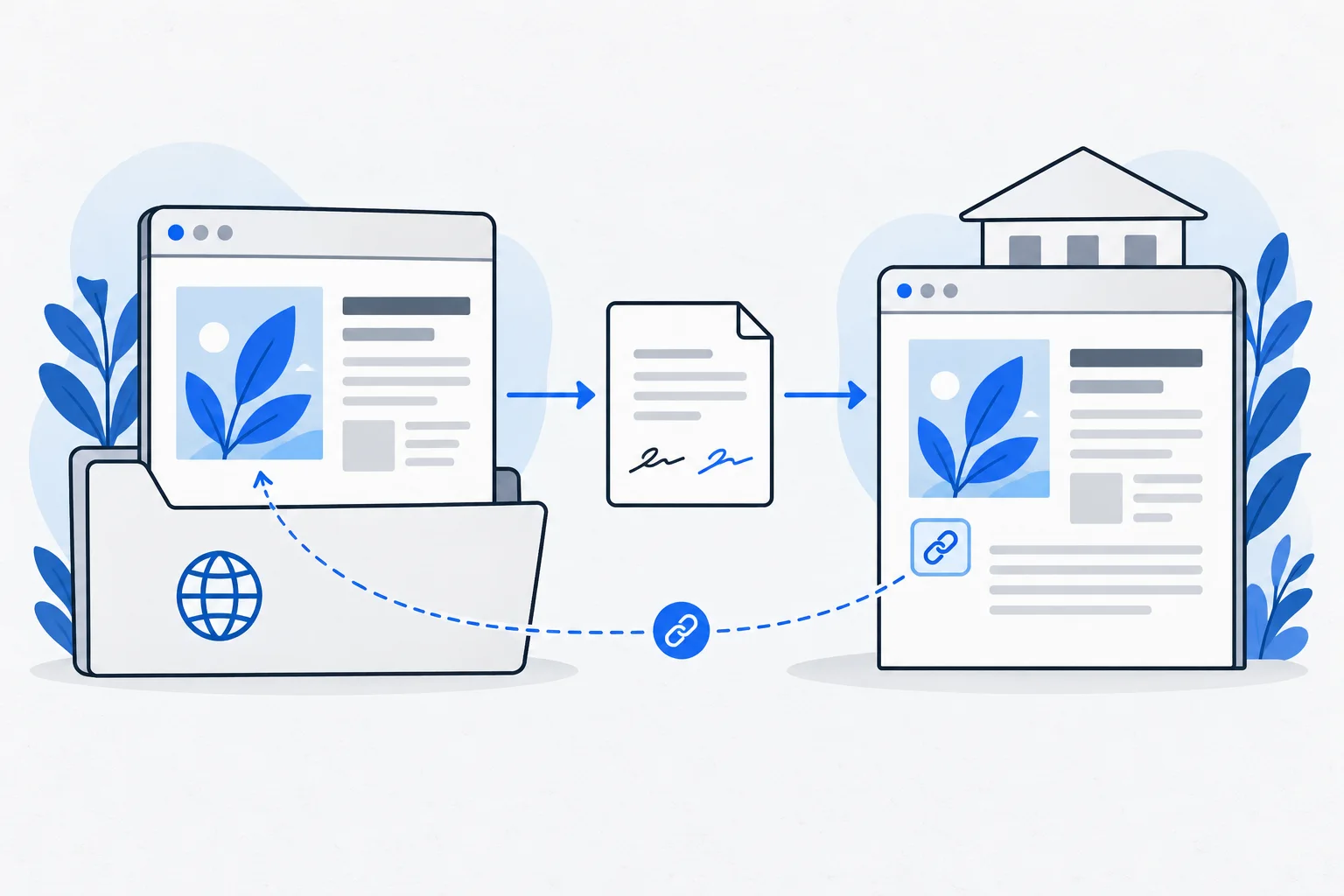
Content syndication is the authorized republication of all or a substantial part of existing content on another platform. It can reach a new audience, while attribution, usage conditions and management of the version appearing in search remain separate matters.
Also known as: Content republication · Syndicated content
At a glance
- A source link is different from republishing an entire article.
- Naming the author does not replace agreement about permitted use.
- Canonical is a signal, not a guarantee that Google will choose the original.
On this page
What counts as syndication?
A professional organization may republish a company’s complete guide with permission, or a publisher may distribute the same article across partner websites. That differs from writing a few original introductory sentences and linking to the source.
Relevant distribution can be valuable even if the partner copy brings no additional organic traffic. Separate the business purpose of reaching readers from the search engine’s selection of a canonical URL.
Agree on the publication details
Clarify what will be reproduced, how the author and original publication will be credited, whether editing is permitted and who will correct outdated information. These are practical editorial responsibilities: otherwise, a corrected original can leave an inaccurate copy elsewhere.
Publication permission and search configuration are separate. Authorized content can still produce several similar search candidates. Duplicate content describes that overlap; it does not automatically mean misconduct.
What a canonical signal can do
Google’s documentation describes canonicalization as a way to indicate the preferred version. Google considers other signals too. A cross-domain canonical is not an agreement that the source page will receive priority in every search. Canonical guidance
Do not rely solely on canonical markup to keep a syndicated copy out of Google. If exclusion is the objective, agree with the republishing site on appropriate indexing controls. Its copy must expose the noindex directive to the crawler. Noindex guidance
Example: a gardening guide on a trade website
Imagine a gardening business whose guide to overwintering balcony plants interests a professional publication. Reaching its readers and building recognition may have value independently of search clicks.
The parties could choose authorized full republication, a short summary linking to the original, or a new article for the publication’s audience. A piece about communal planters in apartment buildings could be distinct if it develops genuinely different questions and examples. Substituting a few words does not create that difference.
Common editorial failures
| Problem | Consequence |
|---|---|
| No owner for updates | A copy stays outdated after the original changes |
| Treating a source link as complete protection | The link alone does not determine canonicalization |
| Calling bulk copying a strategy | The audience benefit remains unexplained |
| Conflicting claims across versions | Readers receive inconsistent information |
Track publication locations, the original URL and substantive edits. Editorial review also applies to the republished version, especially when titles or details change.