Citation rate: how often do AI answers cite your website?
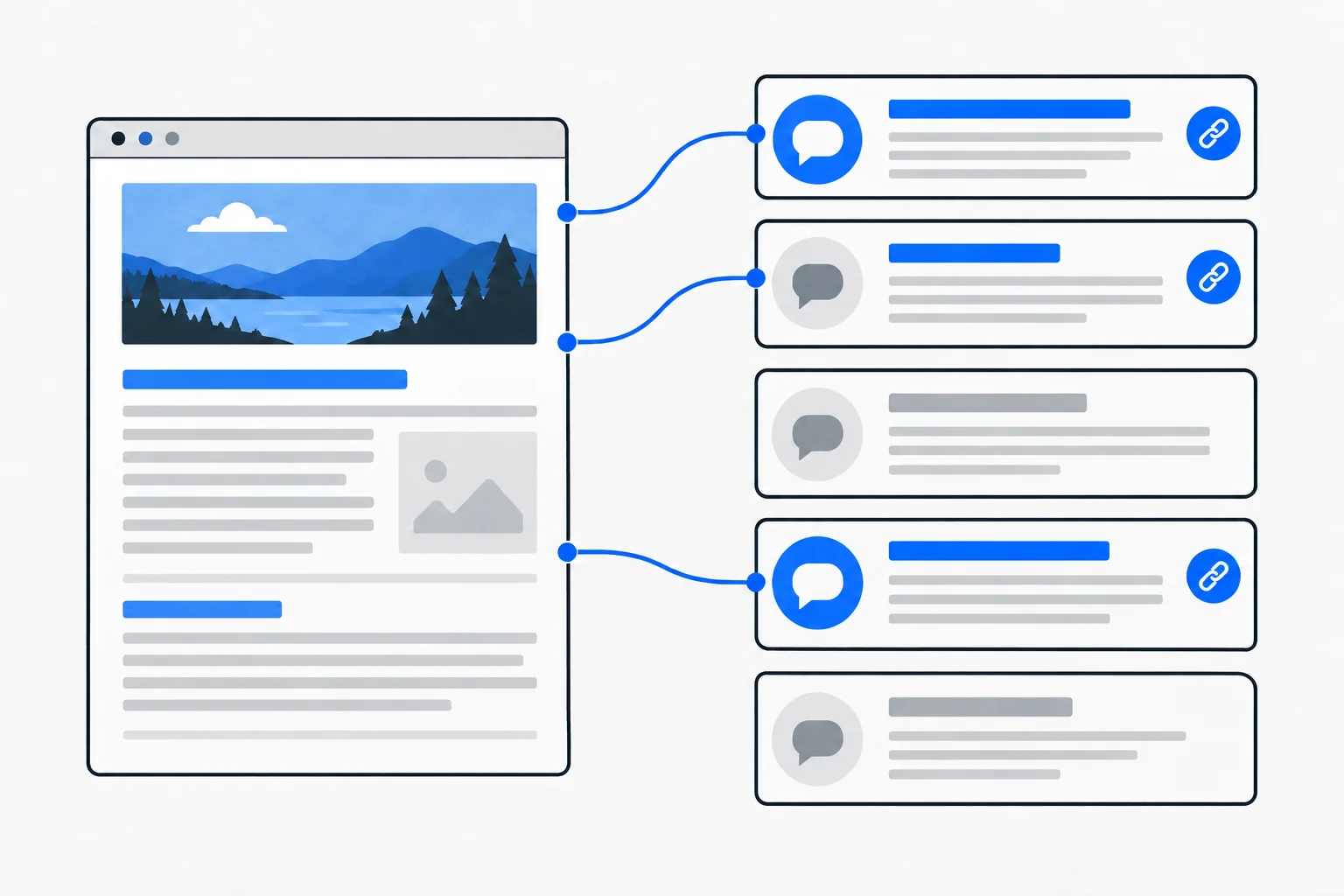
Citation rate is the proportion of answers in a defined sample that cite a selected URL or domain. The definition must specify what counts as a citation and which answers form the denominator. A visible citation is different from a retrieved document or a website visit.
Also known as: citation rate · AI citation rate
At a glance
- Define whether the measure concerns a domain, a particular page or individual links.
- Count each qualifying answer once when calculating an answer-level rate.
- A citation does not establish an accurate recommendation or a website visit.
On this page
How is citation rate calculated?
One answer-level definition is:
Citation rate = assessed answers with at least one qualifying citation ÷ all assessed answers × 100.
This is a stated measurement method, not a universal provider standard. Decide whether a qualifying citation must point to a particular page or any page on the selected domain. Also distinguish visible citations from documents a system retrieved but did not cite.
Example: one domain, several pages
Suppose five out of twenty assessed answers cite a fictional irrigation company's website. Its domain-level citation rate is 25% for that sample.
If two of those answers each link to three articles, the numerator remains five: the unit is an answer. Counting individual links would produce a different measure.
If one particular guide appears in two of the twenty answers, that guide's page-level rate is 10%. Both figures can be correct because they answer different questions.
| Question | Appropriate counting scope |
|---|---|
| Did an answer cite any page on our website? | Domain, counted once per answer |
| Did it cite this particular guide? | URL, counted once per answer |
| How many source links were displayed? | Individual links under a stated rule |
Does a citation mean the answer is accurate?
No. A cited source can be relevant while the answer applies its information to the wrong date, product or situation. Inspect the associated statement as well as the link.
An AI citation is also different from a brand mention or recommendation. A system may cite a business's explanation without recommending its services. Conversely, it may recommend the business using another website as evidence.
Why does the denominator matter?
A rate calculated only among answers containing any citations differs from a rate calculated across all assessed answers. Report which denominator you use. Failed requests and unreadable responses should be disclosed as unknown observations rather than silently counted as absence.
Question selection matters too. Definitions, comparison questions and requests for a local provider create different opportunities for citations. Preserve the question set when comparing periods, or explain how it changed.
Share of voice can use a competitor-related denominator and is not interchangeable with citation rate. Provider dashboards may also apply their own rules; consult the Ahrefs metric definitions or the relevant service's documentation.
How should a business use the result?
Inspect the questions associated with citations and check whether the linked explanations are accurate, current and helpful. Use genuine information gaps to guide new content. A higher percentage alone does not establish a better customer experience.
Keep AI referral traffic separate. A person may read an answer without clicking, and a later visit may lose source information. Different systems therefore cannot always be joined into a perfectly measured funnel from citation to sale.