Chunking: meaning, examples and practical use
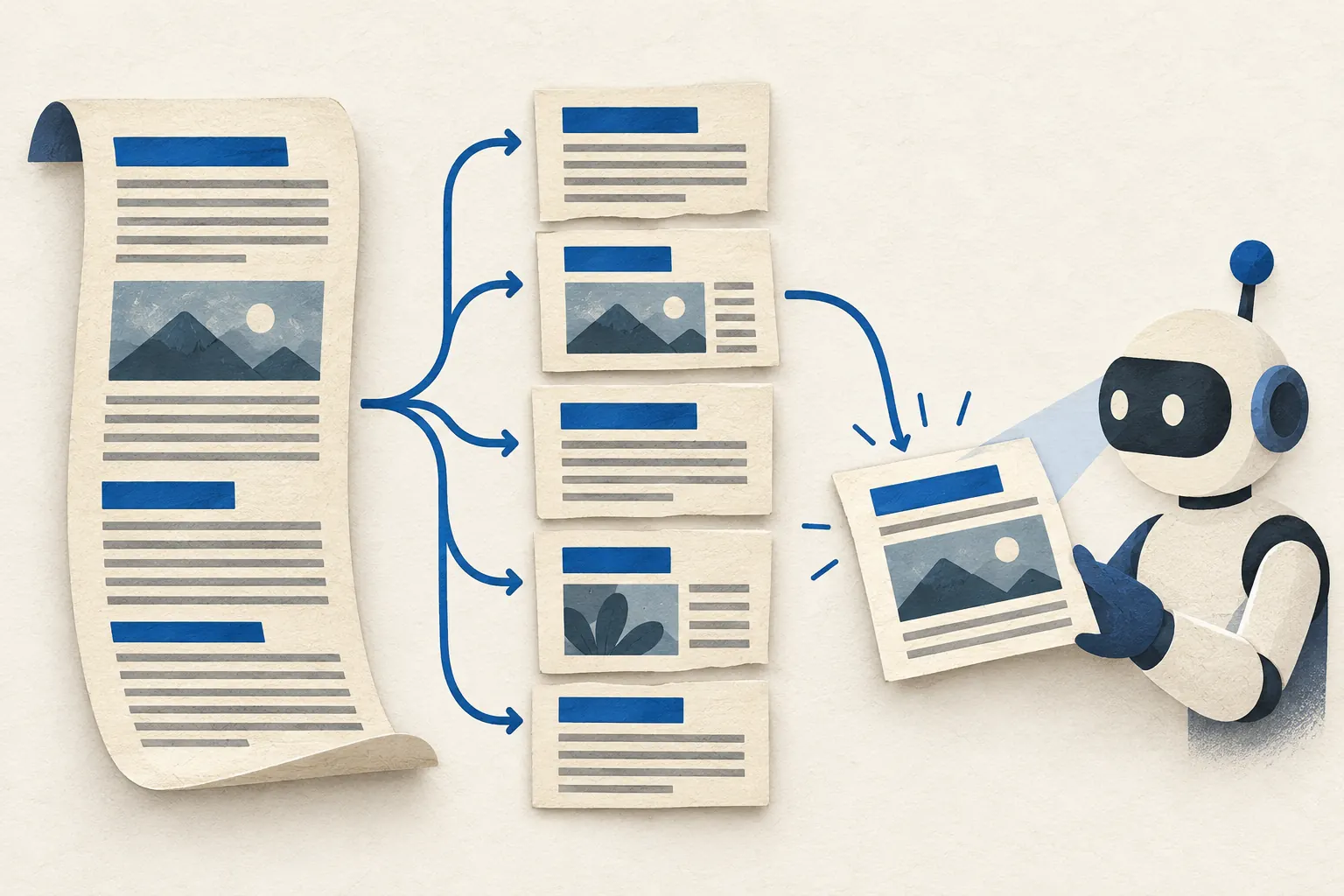
Chunking divides a document into smaller units for processing, retrieval or an AI answer’s context. Chunk size, boundaries, overlap and retained metadata influence which explanation reaches the system together. No single chunk size is suitable for every document.
Also known as: text chunking · document chunking
At a glance
- A passage needs enough context to retain its meaning.
- Chunking is an implementation choice, not a mandatory public SEO format.
- Evaluate boundaries using the documents and questions the system actually handles.
On this page
Why split documents?
A question about a long manual may require only one section. Smaller units can be retrieved independently and placed in a model’s context window. Google’s RAG transformation documentation distinguishes chunk size and overlap settings. Document transformation
A processing unit need not match a paragraph or printed page. Document structure can inform where boundaries fall.
What a poor boundary loses
If a rule ends one chunk and its exception begins the next, retrieval may return only the first. The resulting answer can overgeneralize even though the original document was accurate.
Overlap can preserve some context, but also introduces repetition. Very large chunks may bring substantial irrelevant text into the answer’s input. The choice is a tradeoff, not a universal recipe.
A useful review therefore examines meaning rather than only whether every chunk falls below a technical length limit. A syntactically valid split can still break the explanation.
Example: delivery conditions
Imagine a furniture shop saying that standard delivery ends at the entrance. The next sentence explains that carrying items upstairs requires a separate arrangement. Splitting these statements can obscure the condition or make an optional service appear universal.
Inspect the question, retrieved passage and full section together. A better boundary preserves both the condition and its scope. This is an illustrative document-design example rather than a statement about a real shop.
Keep the source identifiable
Retaining the document title, original location, version and section identity helps trace a passage. Storing it separately must not discard its access restrictions or provenance.
For a public article, use clear sections for readers. Do not claim a particular token length guarantees an AI citation. Chunking inside a RAG pipeline and organizing a useful article are related but separate decisions.